Science context

The term solar-type stars generally refers to main sequence stars sharing with the Sun an extended convective envelope surrounding radiative layers. Such internal properties are fulfilled by stars with spectral types ranging from early-M to late-F (of the order of 20% of all main-sequence stars). At later spectral types, main-sequence stars are fully convective, while stars of earlier spectral types develop a convective core. This definition is sufficiently broad to encompass a large variety of masses, ages, metallicities and rotation rates in a same stellar class. In spite of their large range of fundamental parameters, all solar-type stars share a similar evolutionary sequence, from the accreting T Tauri phase to the cool giant and white dwarf stages. Still, important variations are observed within this general evolutionary scheme, revealing the impact of initial conditions, or the later effect of interactions between the star and its environment.
Some of the most advanced methods available today to investigate stellar physics have been first developed by solar physicists and later transposed to the broader stellar context, in which a wider parameter space can be explored. Famous examples of successful knowledge transfer from the solar to the stellar community include seismology, spectropolarimetry and dynamo modelling. Stellar physics has obviously benefited greatly from this solar heritage. The extension of solar models to a whole stellar class provides astronomers with the unique opportunity to base the exploration of a wide parameter space on an extremely accurate model calibration, using the solar reference. As a result, solar physicists get access to physical processes which may be elusive or absent in the Sun, but much more active in other objects. One example of a physical parameter displaying a striking scatter among solar-type stars is the angular momentum with which they arrive on the main sequence. Identifying the physical processes at the origin of this spin dispersion is a major goal of today’s theoreticians and observers. In any case, the global modelling of angular momentum evolution is especially challenging, as it is linked to a number of different physical processes (i.e. star-disc interaction, mass-loss and angular momentum transport in the stellar interior).
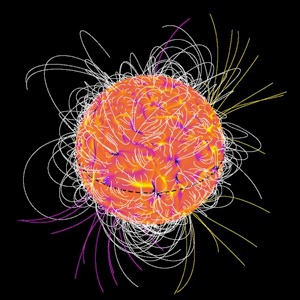
The rotation of solar-type objects, when interacting with convection, is able to trigger large-scale dynamo processes which are at the origin of their widespread magnetism. The efficiency of global stellar dynamos is primarily controlled by the stellar rotation rate and depth of the convective zone. Both parameters display strong variations across this stellar class, generating a wide variety of dynamo output, so that dynamo modes marginally observed in the Sun, or simply inactive in the solar case, can be investigated in solar-type stars. If the activity level itself is a good indicator of the dynamo efficiency, the temporal evolution of the magnetic field (from chaotic to quasi-periodic, depending on the star) also carries precious information about the physical ingredients of the dynamo. In older stars with very slow rotation, basal chromospheric emission indicates that the generation of a weak magnetic field can be driven by the convection alone. Such turbulent dynamo is presumably at work in the Sun as well (together with the large-scale dynamo), but the observation of slowly-rotating stars brings the opportunity to vary the dynamo parameters to the point where this small-scale process can be isolated.
The central objects of most exoplanetary systems detected up to now are solar-type stars. The accurate determination of stellar fundamental parameters are critical to estimate the basic characteristics of their orbiting planets, especially planetary masses, which constitutes a strong motivation to progress in the modelling of cool main-sequence stars, in particular through asteroseismological derivation of fundamental parameters and internal structure. The formation and evolution of exoplanets cannot be disconnected from stellar formation and evolution, and the initial metalicity of the proto-stellar/proto-planetary disc is a critical parameter governing the possible formation of giant planets. Advanced modelling of stellar atmospheres is also critical to get an optimal detection of the tiny signatures of planetary companions, but also to detect and model the spectra of exoplanetary atmospheres. Finally, the level of stellar activity is directly impacting the planet habitability, in particular around young, highly active solar-type stars.
Credit: Tom Kerr
Credit: Sacha Brun
Credit: NASA